
Lex Icon
Salette Tavares (Ugly Duckling Presse, May 2024) Translated by Isabel Sobral Campos and Kristofer J. Petersen-Overton
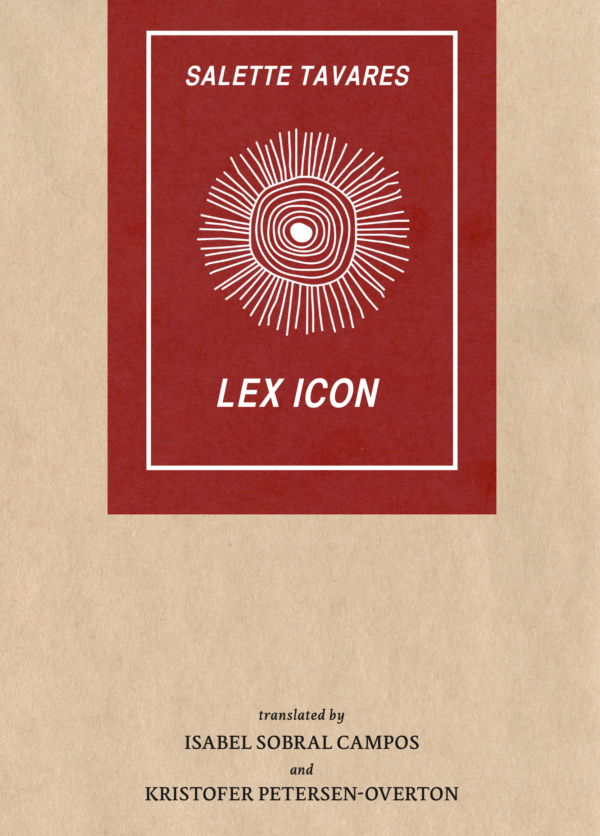
Appearing for the first time in English translation, LEX ICON presents everyday objects through the lens of modern art and abstraction. As abstraction distills the geometrical shape of an object by shedding its function, so too do Tavares’s poems distill the essence of everyday items in language. LEX ICON connects Tavares’s early poetry to her later graphic sculptural poems. Foregrounding insights into human sociality, labor, and domesticity that dwell in simple household objects, the poems collected here also present these as almost mystical artifacts that partake in some unnamed ritual.
Praise for Lex Icon
“Salette Tavares’ Lex Icon is a tour de force that catalyzes the dualistic tension between word/thing and human/artifice. The book acts upon the distrust of language and reality, foreshadowing contemporary debates between Continental and Analytical philosophy and within the seductive illusions of the disinformation age. In poems on the peculiarly boundaried nature of our shared material reality, Tavares explores an anarchic and cinematic Welt (mundo, world, ālam) rich in the abecedarian and profane. Her text’s elliptical bangs, pauses, reverbs, and collisions roam the psychoanalytical and phenomenological, the theatrical absurdist and the empty room. Informed by sensibilities both Beckettian and Buddhist, poems with seemingly innocuous titles like “Tablecloth” train our attention back on language and object, whose domesticated familiarity we have long taken for granted. Isabel Sobral Campos and Kristofer Petersen-Overton’s first collaborative translation awakens Tavares’ penetrating, methodical, and pugilist poetry for readers of English and lays a gilded wreath around its astonishing feats.”
— Maryam Monalisa Gharavi
— Maryam Monalisa Gharavi
“Reading these poems I can’t but think of an exquisite, part Surreal, part Fluxus dinner party with Francis Ponge, Ana Hatherly, Marcel Duchamp, Kurt Schwitters, John Cage, Matisse, and the De Campos brothers seated at the table amongst Salette Tavares’s family members and others. At some point they’d all perform “Shoe,” an absurdist liturgical poem and perhaps the most subversive text in this book allowing us to witness the radical transfiguration of the quotidian before our very eyes.”
— Mónica de la Torre
— Mónica de la Torre